Wednesday, February 26, 2014

The muddy road


Street kids in Hanoi generally have one thing in common: They are not from Hanoi.

Over the past 11 years of meeting street kids, only a handful have been from this city. Almost all are from the countryside, leaving behind rural poverty with the dream of a better life in the big city. 

And so an essential part of Blue Dragon's work involves taking kids home to their families. We can sometimes call families in to meet us in Hanoi, but more often we need to travel with the children out to rural villages. 

Don't make the mistake of thinking these are fun trips out to quaint vineyards, or scenic tourist trips that Blue Dragon staff love to take. The kids we meet on the streets of the city are invariably from extremely poor families in extremely poor communities. And getting there can be a serious challenge.

Yesterday (Tuesday) one of the Blue Dragon team traveled out to Lang Son province with a boy, "Thuy," who we met on the streets but has been living in our Shelter for about a year. His relationship with his father is complicated, to put it nicely.

Little Thuy, aged about 13, has been dealing with some inner turmoil of late. He desperately wants to be able to live at home again, but deep down knows it's not possible. Dad has too many of his own demons to battle; raising a child is simply beyond him. But still, Thuy needed to see his father, and so we went.

A few years back some great friends helped Blue Dragon buy a car for just this sort of trip. We're incredibly lucky to have it. However, as with many similar trips, the car isn't enough to get us where we're going. Quite a bit of walking was also involved.

 Here's why:

There are just some bridges that no car can cross!

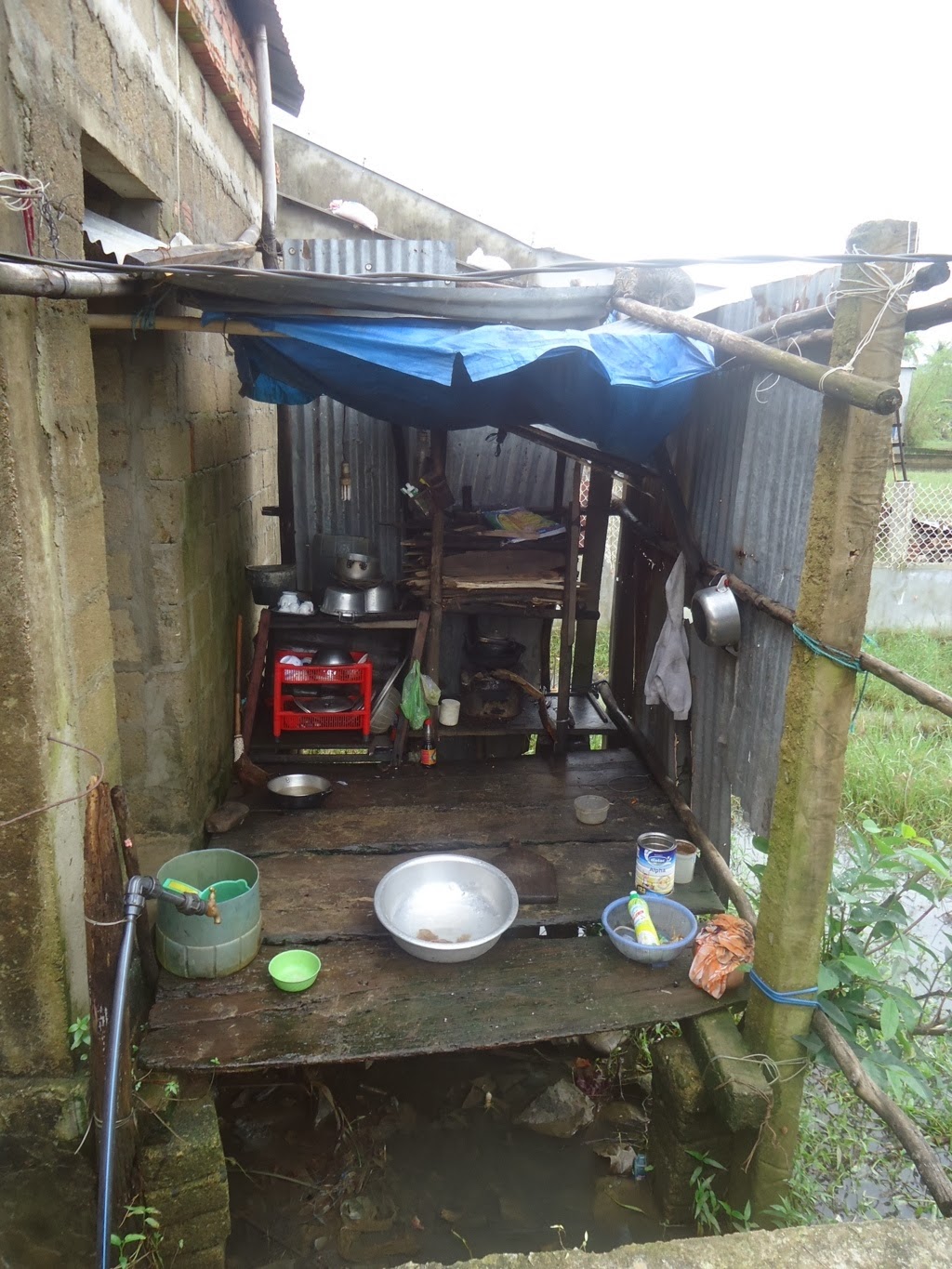
And after the bridge there was this: 


Lots, and lots, of mud. Followed by more mud.


At the end of the muddy road, we reached the family home. 


Thuy was nervous about seeing his father - his last trip home ended very badly - but having a Social Worker alongside him made all the difference. At the end of the day, Thuy decided to spend the night at home and return to Hanoi by bus.

Among the Blue Dragon team we laugh about the impassable roads that we face on these reunion journeys. There's something symbolic, though, in the great struggles that we face in order to return to the family home. It's never easy: not for the kids and not for the staff. Certainly not for the Blue Dragon car. But at the end of a long and difficult journey there is a reward, or at least the hope of one, and the chance for a family to make a new start.

Thursday, February 20, 2014

First day back

The Tet (Lunar New Year) holiday already seems like ancient history, even though it ended just a couple of weeks ago. But the Year of the Horse is off to a swift start, and I can see that this will be a big year for Blue Dragon.

- The exploitation of street kids in Hanoi stands out as the most pressing problem we face right now. There's a growing group of adults, both men and women, who seem to think that homeless kids are 'fair game': that they are there for exploitation and abuse without consequence. I'll be writing more about this in coming months, and I am looking forward to proving that there are indeed consequences for exploiting homeless kids. Stay tuned.

- Two trafficking cases have come to us already, and we are still in the investigation stage so I can't say too much. While it could be disheartening that trafficking is so common, there's great encouragement in the fact that both regular citizens and government agencies are so active and involved in finding, reporting, and resolving trafficking cases. During the coming year, I hope to post plenty of stories of successful rescues and the arrest of lots of traffickers.

And although these are big issues, the greatest satisfaction as always is in the stories of the kids: the individual girls and boys whose lives we touch and transform every day.

One of the Blue Dragon boys, "H," has just returned to school after 6 months. He's been living on the streets, in and out of trouble, on the run from a family that doesn't know how to care for him. 


Aged 13, H simply doesn't know how to manage his own behaviour or make good decisions; he's been like an explorer without a compass, wandering alone and making his own way.

Shortly before Tet he meet the Blue Dragon Outreach Team who took him in and gave him a place to stay while he works out what he's going to do. Now that he's back at school, he has moved into our Shelter to live with other kids just like himself.

Going back to school after surviving on the streets is no easy matter. It's hard for a teenager who has had freedom to roam at will, make fast money and live for the moment to suddenly start complying with the endless rules and regulations of Vietnamese school.

When H first went to the school to ask to join a class, one of the teachers grabbed a pair of scissors and cut his fringe - right in front of a Blue Dragon Social Worker! The poor little guy was devastated to see his beloved long hair stolen away like that.

It seemed that his hair was simply too long according to school regulations. I was so excited that he was simply prepared to return to school, but the reality was that his commitment to study was not enough. He also needed short hair.

Despite that unnecessarily rocky start, H has had his first day back at school, and was still smiling at the end of it. That's a huge success.

Will he get through another day? That remains to be seen. I think it's best to accept the small victories as they come, and H's first day back at school is something I can definitely celebrate.

Friday, January 24, 2014

This is how we do it

The weeks leading up to Lunar New Year (just 6 days to go!) are all about celebration and festivity. As they should be!

But at Blue Dragon, we also have an eye on something a little more serious... Because the weeks after Tet are prime time for child trafficking.

When all the kids are still at home, and families have exhausted their meager savings for the holiday period, and the economy goes through a slump, human traffickers roam impoverished villages selling their 'snake oil'.

They offer 'vocational training' but in reality just want vulnerable children to slave away in their factories. They offer sweeteners to families, such as a $50 'advance' which in effect means the family enters debt bondage and is unable to see their children again until the end of a 2 year contract - at best.

To counter this, Blue Dragon staff have been spending time talking to families, community members, and officials to let them know the reality of life for trafficked kids.


One such meeting, in a village in rural Hue province in the centre of Vietnam, gathered about 30 people together last weekend. A local official who has traveled with Blue Dragon to look for trafficked children recounted his own experience of going into squalid factories and finding children asleep at sewing machines, or working through the night, and crying with relief at the news that they were finally allowed to go home.

These meetings are small scale, but word quickly spreads through the villages, and the impact is profound. When community members hear first hand stories of what happens to their children who are taken away from home, they resolve immediately to never let it happen to their own family. And once a few families start talking about how bad it is to send children away, the whole culture of the village changes very quickly.

Child by child, family by family, village by village, district by district. This is how Blue Dragon is working to end the trafficking of children into the garment industry.

Wednesday, January 22, 2014

Biggest night of the year

In January every year, Blue Dragon in Hanoi organizes an event that we call the Tet Awards. It’s a night of celebration, games and fun to put the spotlight on each and every girl and boy who belongs to the Blue Dragon family.

Last week we held the 9th Awards Night, with more than 400 children in attendance, as well as family members and friends from the community. It was great to welcome the Ambassadors of Australia and New Zealand, and friends and supporters from local business and the Hanoi International Women’s Club.

In short: it was another amazing Tet Awards. The performances by children and staff were both touching and entertaining. Some of the kids who got up and danced have had the most horrendous time in the past year – and some have had whole lifetimes of trouble. But none of that mattered on the night. It was all about celebration.

Here are a few photos to give a glimpse into what Tet Awards is all about. And next year will be the big Number Ten… somehow we need to come up with something that will be even greater!


Kids and family members arrived early... 


The face painting was a blast! 


Through the night, kids with outstanding achievements received a Special Award...


Children and staff performed together...


... and at the end of the night, everybody wanted their photo taken! 


Thursday, January 16, 2014

The workplace

On Tuesday this week, Blue Dragon found a nondescript house in Ho Chi Minh City where 3 teenage girls, all from ethnic minority communities in north-west Vietnam, were being forced to work against their will, for no salary.

Locating this house was the result of weeks of detective work. Our breakthrough was in meeting some children in a remote village who had been enslaved in this garment factory themselves, and had escaped; they could give us enough of a description of the street that after 2 days of searching we were pretty sure we had the right place.

"Pretty sure" isn't a great starting point for a raid on a home, and the factory owner had gone to great lengths to conceal his crimes. When the Vietnamese anti-trafficking police searched the building, they finally found the girls locked into a closet, terrified into silence and stunned to learn that we had come to set them free.

As you can imagine, the girls were hugely relieved to finally have a ray of hope. The had been locked in to the building for 11 months, allowed out just once a week under strict supervision. During their time at the factory, they were never paid, never allowed to call home, and a typical working day was at least 14 hours long.

The upstairs room where 3 girls lived and worked for 11 months

The girls are now on their way home; a journey of more than 2000km. Their reunion is sure to be a very happy one.

Tuesday, January 14, 2014

New year, new house

Here's some good news to start the new year.

When Blue Dragon found 13 year old Lanh enslaved in a garment factory and brought him home, we were shocked to see the state of his family home. It wasn't just a little run down; it was barely habitable.

Bringing trafficked children home is not the end of our work or our responsibility. Home has to be a safe place; it has to be a place that the kids want to be. We can't just drop the kids off and hope things work out better for them. We have to make sure things will be better.

And so we put out a call for help to a group of friends and volunteers in Sydney, who call themselves the Blue Water Dragons. They responded by raising the money - about $2500 -  to completely renovate Lanh's house and make it a home that the family could be proud of and comfortable in.

Here's the "Before"...

Front view of the house. 

The front room - with Blue Dragon staff visiting.

The rear of the house...

 ... and this was the kitchen.


And here's the "After." Spot the difference?? 


The new front view

The front room - now with a proper floor!

Interior view

And a new kitchen!

Lanh's home is looking great, and it's all ready in time for the Lunar New Year (Tet) which is coming soon. This is one very happy family.

Here's to hoping we can do the same for many more families in need this year! And a huge THANKS to the Blue Water Dragons for making this possible.

Monday, January 06, 2014

A New Year's Resolution

2014 marks the beginning of Blue Dragon's 10th 'birthday'. Sort of.

We started in late 2002, as a few volunteers helping out some street kids in our spare time. During 2003, we got serious about becoming organised and finding ways to help for the long term. We started the soccer team - originally Real Betis Vietnam, and now Blue Dragon United - and also started our first shelter, a boys' home called The Big Room.

But it was in 2004 that we became 'officially' recognised as an NGO (ie a registered charity) both in Australia and Vietnam. So in a sense, this will be our 10th year.

During our first few years, we faced considerable opposition. Some organisations and NGOs were great, spending time advising and supporting us. Education For Development, Catholic Relief Services, and the New Zealand Embassy were particularly helpful in those first months and years.

But surprisingly, some organisations and people were outright negative. "You don't know what you're doing," they'd say. "You have no track record. You're not an expert."

I don't disagree with them. In some ways, they were right: those of us who started Blue Dragon had very little experience in working with charities, and no experience at all in setting up or running an organisation.

And yet, looking back on this time, here's my conclusion: Our lack of knowledge and experience turned out to be our greatest strength.

We weren't afraid to try something that others thought would fail. We weren't afraid to 'roll the dice' and give something a shot, no matter how unlikely a good outcome seemed.

We didn't start with plans and budgets and setting up bureacracy. We just got in there and helped, and let the money and the administration catch up later.

One example: in 2005, we started tackling the issue of domestic trafficking - ie the trafficking of children within Vietnam for labour exploitation - before it was recognised by the law, and before any other organisation (that we know of!) was dealing with it. We found kids who had been trafficked to work on the streets or in factories, and we took them home. What was once a little-known issue is now a well known problem which provincial governments are working to address. Blue Dragon played a key role in creating that change.

Ten years down the track, Blue Dragon is significantly larger. We have over 1500 kids in our care. We have social workers, lawyers, teachers and psychologists working together on cases throughout the country, and sometimes in China as well. We've rescued more than 300 trafficked kids and helped about 2700 kids attend school. Nobody can accuse us now of not knowing what we're doing.

But do we still have that same drive and passion as ten years ago? Are we still bold enough to take the risks?

The danger, as Blue Dragon grows older and wiser, is that we become inward looking and self serving. We've taken so many blows; why not now take it easy? Deal with some simpler cases?

Last year in particular was a tough one, as I wrote about here: The Year of the Crisis. We focused heavily on finding and helping kids in serious danger: street kids vulnerable to sexual exploitation, and young people trafficked for labour and sex. We achieved some great results, but the cost was a year of incredible stress for my team.

And so, what of the year to come?

The start of a new year is a time for resolutions and dreams. As Blue Dragon enters its "official" 10th year, those pronouncements hold an even more important symbolic value.

My resolution is this:

To never be complacent. To stay hungry and determined. To keep pushing the limits, trying new ways to help kids in crisis, getting out of our organisational comfort zone and being where we need to be.

This will be a year for innovation rather than 'more of the same.' We will make great progress in the fight against human trafficking, and we will make sure that Hanoi's street kids are safer for our presence.

And I look forward to sharing the journey with you right here on the blog.

Monday, December 30, 2013

What did Blue Dragon do in 2013?

Here's a snapshot...

- 162 street and homeless children received help from the Street Outreach team.

- 56 street children were reunited with their families. 

- 19 rescue trips brought home a total of 82 victims of human trafficking from brothels and factories.

Children trafficked for work in garment factories: April 2013

- 20 human traffickers arrested, and 10 sweatshops penalised for using child labour.

A sex trafficker is taken into custody: March 2013.

- 4 victims of sex trafficking represented in court.

- 836 children and family members received legal registration papers, such as birth certificates and identification cards.

A Thai woman in northern Vietnam with her legal documents: December 2013.

- 715 children and families received legal advice.

- 20 children and youth in conflict with the law received legal advocacy.  

- 1205 children went to school, with full support for school fees, uniforms and study gear. 

- 53 teens studied at Vocational Training centres. 

- 76 tertiary students received scholarships and support.

Tertiary scholars gather to plan their year: October 2013

- 5 houses built.

- 83 kids taken to a doctor or hospital.

- 112 children received a bicycle to go to school.

- 50 life skills workshops were held for children and family members.

A workshop on Keeping Safe: November 2013.  

- 31 victims of child sexual abuse received legal advocacy and emergency care.

- 104 children stayed in Blue Dragon's short term accommodation. 

- 112 children and and teens lived in Blue Dragon's long term accommodation.

- 36,080 meals served to hungry kids.

- 8,160 kg of rice distributed. 

- 183 games of soccer played.

- ... and our work all around central and northern Vietnam meant that the trusty Blue Dragon car drove a total of 41,199km!


P.S. We're not sure how to measure fun, but we had loads of that, too!!

 A performer from Circa teaches the kids some tricks: November 2013.

Monday, December 23, 2013

The Year of the Crisis

2013 has been a challenging year.

And that's putting it nicely. Looking back, I will have to call this one the Year of the Crisis.

It's often been difficult to share the stories of what has happened at Blue Dragon during the past 12 months. There have been many times I have wanted to write about an issue or a special case, but have had to hold back. Most of the cases have involved child sexual abuse, and so have involved police investigations. All up, we have worked with more than 30 individual cases of children being sexually exploited, both girls and boys, and I have no simple explanation for why the number of cases has been so much higher than previous years.

When Blue Dragon meets a child who has been the victim of exploitation, we take on many roles:

- we offer emergency accommodation and care;

- we organise a health check at a clinic;

- we provide counselling, which is sometimes formal and sometimes simply involves 'hanging out' and building a trusting relationship;

- we assist the child to make a statement to the police, and provide legal advocacy from beginning to end;

- and finally, when the child is ready, we develop long term plans for stable accommodation, schooling, and family reunion, if possible.

We've found over the year that most of the 'exploiters' target the kids very carefully. They choose victims who are estranged from their family, desperately hungry, and seeking friendship.


Our response has been to get Blue Dragon staff out onto the streets day and night, meeting kids in places where they commonly gather and developing networks among street workers who can call on us when they meet kids in crisis. This has been hugely effective, and as the year has gone on we've been able to get to homeless children and youth early enough to protect them from exploitation. We've likely saved at least another 30 kids from being exploited. 

This work is in addition to the rescues we've done of young people trafficked to China for sale to brothels, and children trafficked to sweat shops in southern Vietnam. Those cases have involved painstaking investigation and legwork, often out in the remote rural areas which are considered 'safe targets' by the traffickers.

While the rescue trips have so far all been successful, every case is played out with bated breath. What dangers lay in store? Will the traffickers know we are coming? Do we have the right information? What if we travel from one end of the country to another and find nothing? While we rarely say much about the details of the rescues - we need to be reasonably discrete to make sure we're safe - there have certainly been some trips this year that had very tense moments.

Our older kids have had tough years, too. As they grow up and move on, we normally stay in contact and catch up when we can. That often involves helping out when problems arise: when someone is arrested, or injured in an accident, or passes away. This year two of our older kids died of illness: 19 year old Yen, and 25 year old Huy. Other kids have spent time in hospital, lost family members, or been arrested for various offenses. One of the teens we were working with on the streets has been charged with murder; there's very little we can do for him now.

There's a lot about 2013 that I am glad to put behind me. But I've also seen some true beauty in the Blue Dragon kids, staff, volunteers and supporters.

Just a few examples:

- After speaking at a school in Singapore about the life of Vietnamese street children, two little girls approached me with all the loose change they had in their pockets. Moments like that are deeply moving; they remind me that there really is good in the world, even if it's sometimes hard to find.

- Earlier in the year, we had a group of teenage girls who had escaped from sexual abuse and needed to stay with Blue Dragon for several days while we helped them make statements to the police. I emailed all my staff asking if anyone could volunteer to work some night shifts to look after the girls, and was inundated with offers of help. I really do work with an amazing team. 

- One of the Blue Dragon boys, who has been through an extremely difficult time these past 2 years, asked my staff why I stay in Vietnam for Christmas and don't return to Australia. The staff suggested that maybe I can't afford the ticket back, so I prefer to stay here, at which the boy said he wanted to save his breakfast money to buy me a plane tickets. Rest assured, I won't be taking him up on that offer, but what a show of compassion from a child who has so little.

So it's been a tough year, but with lots of bright spots throughout. Thank you to everyone who has cared, emailed, donated, visited, or followed the adventures of Blue Dragon in 2013. You can't imagine what your encouragement has meant to me and my team. And very special thanks to friends in Australia, Singapore and the US who hosted and met with me in my travels.

Here's to better days ahead. There are surely plenty to come.


Tuesday, December 17, 2013

Make me legal

Khanh* was a 13 year old orphan when we first met him on the streets.

Both of his parents had died several years before, and he had been raised by uncles and aunties who were basically good people but didn't want to be burdened with somebody else's child. They made their feelings obvious, so one day Khanh grabbed all he could stuff into his pockets and left town.

Once in Hanoi, Khanh met up with other homeless youth and drifted about. Street kids tend to be pretty creative when it comes to surviving; Khanh was no different. He lived on bridges, found abandoned shacks to stay in, and moved from place to place. He doesn't like fighting and isn't an aggressive person, so he would often move on to a new location rather than stand his ground when rival gangs turned up or somebody came to cause trouble. Every day started with Khanh wondering where he might sleep the next night.

Hanoi's street kids often live on bridges 
or in concealed spots, away from the public.


Blue Dragon's Outreach team met up with Khanh and brought him to the drop-in centre, but he was reluctant to stay with us for very long. Khanh feared that we would force him to go home, or treat him like he had been treated for the past few years. For now, all he wanted was freedom.

His freedom came at a cost. In order to eat, Khanh needed money, and so he soon found clever ways to get by. He's an ethical young person, and didn't want to rob people or break into homes, so he instead carved out a niche in metal recycling. Unfortunately, his metal was all part of a park fence that he set about dismantling... and when the police found him taking apart public property, he was arrested and sent to reform school.

During his 18 months there, we visited when we could and brought warm clothes for the winter. Khanh worked hard and studied well, and so was released early - but was back on the streets in no time. He connected with Blue Dragon straight away, but at the same time was being targeted by adult gangs who saw a good looking kid and just wanted to exploit him.

After a couple of months, Khanh was ready to leave all this behind. We saw him one day in April on a bridge over the Red River, invited him to come and live with us, and he's been with Blue Dragon ever since.

Khanh's transformation into a studious, hard working 8th grader has been amazing to see. He's no angel, but he's honest and caring, and intensely loyal to both friends and Blue Dragon staff.

The all-important personal papers. 


Khanh's story is a good case study in how Blue Dragon's multidisciplinary team works together. Outreach workers, Social workers, Lawyers, Teachers and Shelter staff have all played a part in Khanh's decision to leave the streets, live in a home, and return to school.

Just a few weeks ago, one of the Blue Dragon legal team accompanied Khanh back to his village to meet the local government and obtain the all-important personal papers that he needs to continue at school. In coming years, those papers mean Khanh will be able to get a proper job, a motorbike license, and one day get married or rent a home of his own.

One way to look at what we've done with Khanh is this: We've worked to make him legal. He's no longer homeless, no longer stealing to survive, no longer living without official identification and paperwork.

Blue Dragon meets many young people like Khanh - sometimes 5 or more in a week. That's why, this Christmas, one of the wishes on our list is for donations to obtain legal identities for children (more info about that is here).

It's an unusual request for a Christmas gift, but street kids don't have time for luxuries. First they need the basics.

Now that Khanh has settled down and is doing well, he's starting to imagine a future. Nobody who meets Khanh can guess at the troubled start he's had in life - he's just an ordinary teenage boy who likes computer games, girls, and hanging out at Dragon House.

But he has the basics now; he's safe and happy; and the future is his own to create.


* Not his real name. 

Friday, November 29, 2013

Farewells and wedding bells

This weekend, two of the Blue Dragon boys are setting off on new and great journeys.

Duy Nam first joined Blue Dragon in our early days: August 2003. Nam was shining shoes near a television station when I met him, and he was so eager to climb out of poverty that he immediately joined Blue Dragon's football team. Despite living on the other side of the city, he would travel by bus every Sunday morning to arrive at the field by 8am and play before heading back to work.

Nam needed surgery, so we helped him with that and he returned with his mother to his family home to recover. It was almost a year later that Nam moved back to Hanoi to live in The Big Room, which was Blue Dragon's first home for street kids. He distinguished himself as the most hard working of all the kids we met, and also the wisest: the other children nick named him Tam Mao, after a wise character in Chinese mythology.

After some study, Nam went to work for Hanoi restauranter Donald Berger; and almost 10 years later, Nam is still working for Donald in the role of sous chef. He's 3rd in charge of one of Hanoi's finest restaurant kitchens, has won awards in Iron Chef, and this Sunday, Nam will marry.


This is a big wedding for Blue Dragon. Nam has such a long and strong history with us, and he's one of our best respected young people. I think the Blue Dragon team will be taking up a lot of space at the wedding party...

(And a note for non-Vietnamese... One of the traditions here is to take wedding photos before wedding day - hence the photo above!)

But meantime, we are saying farewell to another of the Blue Dragon boys who is heading oversees. We first met Can in 2006 in Saigon, where he was working on the streets as a flower seller. He's been with us since, although for 4 years he studied at Chatsworth International School in Singapore on an extremely generous scholarship.

Armed with an international education, Can has now been offered a full scholarship to study in Auckland, New Zealand, at NTEC. He will be studying a Business Management degree for at least 2 years, which means being away from home for a very long time.

Can flies tonight (Friday), so we're all taking time to say goodbye and wish him well. Tonight we'll head out to the airport to see him off, and a whole entourage of his friends will be there. He's very much loved.

Can's farewell party! (That's Can with the badge on his jacket)


I remember those early days of Blue Dragon, 10 long years ago, when we wondered if we really could help Vietnam's street kids to change their lives. Nam and Can seem to be an answer to that question. They are remarkable young people who just needed a helping hand to get out of crisis - and now they're flying!


Saturday, November 23, 2013

The best and the worst

In the last few weeks, Blue Dragon has been focused on intervening in human trafficking, particularly of children from Dien Bien province.

Dien Bien is a beautiful part of Vietnam, with diverse ethnic groups and beautiful scenery as far as the eye can see. But its remote location, mountainous geography, and endemic poverty make it a haven for traffickers looking to exploit children.

A common sight in Dien Bien: 
families living traditional lifestyles.

Blue Dragon's involvement in the province began just 2 years ago. Since then we have been involved in rescues of girls and young women trafficked for the sex trade, and both girls and boys trafficked to southern garment factories. Just a week ago we rescued 16 children, aged as young as 11, who had been enslaved in factories.

The youngest had been in the factories for 11 months. They hadn't set foot outside once.

The oldest, aged 16 or 17, had been there for up to 3.5 years. They too had not been allowed out. They were locked into upstairs workshops where nobody could see or hear them. It took Blue Dragon's anti-trafficking team weeks of searching to find the factories, and to be sure we had the right places.

Not only were the kids locked away, but they were denied contact with their families for the first 2 years of their 'employment'. After 2 years, they were allowed to talk to their parents on a mobile phone; but the traffickers were standing right there throughout the conversation, and the kids could only speak in Vietnamese. The children, however, are all from ethnic minority communities where Vietnamese is not their mother tongue. It's likely that their parents, on the other end of the phone, could hardly understand a word.

 A trafficked boy returning home after 2 years.

And then this week Blue Dragon represented a young woman in court, also in Dien Bien, where her trafficker was charged and sentenced to 11 years in prison. The trafficker was a young woman, in her early 20s. Illiterate and poor, she heard that she could make some fast money by tricking girls into following her to the Chinese border, then handing them over to brothel owners on the other side. Blue Dragon was involved in the rescue of this young victim some months ago, and we were glad to see the case resolved with justice done.

The traffickers, brothel owners and factory owners all know that they're doing wrong. There's no question about that: they try to hide their activities and do their best to avoid detection. But when caught, they all have justifications for their actions.

Without fail, they insist that what they were doing isn't a big deal. If they didn't do it, someone else might. The kids were poor anyway, so maybe this was a better chance for them.

It's a sad insight into human nature that people do this. We do this. I can't imagine a dog trading its young, and yet the most intelligent creature on earth does.

But that's only half the story. The other half is the compassion and commitment of those who fight against trafficking: the parents who don't give up; the kids who rebound even after years of being locked up; the police who travel from one end of the country to the other to raid factories and catch traffickers.

One of the joys of being part of Blue Dragon is that, while we see the very worst human behaviour, we also see the very best. And the best of the best is the inspiring resilience of the young people who, time and again, get their lives back together and face the future with a bravery I cannot conceive.

The fight against human trafficking has a long way to go. But as long as there is some goodness in people, there's always a chance we will win.

Friday, November 08, 2013

A new home

Six months ago, 13 year old Tiep* thought that life had no hope.

Deceived by a trafficker pretending to have 'training opportunities' for disadvantaged youth, Tiep's parents agreed for him to leave home and learn a new skill, which they hoped would guarantee him a better life.

Instead, Tiep was taken over 2,000 km (1,200 miles) from home and put to work 16 hours a day in a small factory. There was no salary, no day off, and no training or education.

Blue Dragon found Tiep and took him home in July. It was immediately clear that his family's extreme poverty was the main reason they were vulnerable to trafficking: their family home was in ruins, and they had no money to repair it, let alone pay for their children's school fees.

Apart from helping Tiep home and supporting him to return to school, Blue Dragon agreed to rebuild their house. As the family belongs to the Thai ethnicity, we've had it built in the local style, and as of today the house is almost completed. In the coming week the floor will be finished and the electricity connected. Tiep and his family are thrilled!

But the best part has been seeing the whole community chip in to get the house built. The village has no money at all to contribute, so instead people have helped with the construction even though it's also harvesting time for most families. Some local government officials have been involved too, helping with the design and making sure we stick to budget. It's really been a 'whole village' effort.

Yesterday we had a small gathering to congratulate the family on their new home. Tiep's mother was close to tears as she told us that she never thought her children would have a proper roof over their heads.

What a delight to help this family get their lives back together.


* Not his real name

Tuesday, October 22, 2013

It's all about people

Before moving to Vietnam in 2002, I was a school teacher for 4 years and also worked in an Australian charity for 6 months. Blue Dragon Children's Foundation has now been running for about 10 years. So all up, I have a fair bit of time working in service roles. 

The more experience I gain, the more I understand that systems don't help people. People help people.

We're always looking for ways to boost productivity, enhance performance, and duplicate models. But in the end, our world is full of people, and if you want to impact their lives then it all comes down to YOU. It's not about what kind of a system you set up, or what kind of model you develop.It's about you.

Charities succeed or fail depending on their people. I imagine businesses would say exactly the same. You can have all the slick marketing that money can buy, but if your salespeople or customer service staff are rude or incompetent, then chances are you're going to fail.

In creating Blue Dragon, all I ever wanted to do was help a few kids who were having a rough time and had nobody else to care for them. That was the whole vision in the beginning, and it's not very different now. Even with over 1500 girls and boys in the Blue Dragon family, it's still all about caring and lending a hand.

Today my team in Hanoi had a beautiful insight to how we have impacted on the life of one of our boys - who I'll call "Hao".

One of Blue Dragon's Outreach workers met young Hao, now aged 14, on the streets of the city early this year.  He's now in school and living in the Blue Dragon Shelter.

Unbeknownst to us, Hao's school teacher this week asked him to write a story about someone who has helped him, or someone he has helped. Below is a translation of what he wrote. I'm very proud of him for writing this, and pleased that he had the confidence to share his story.

When I was 12 years old, my father died in an accident. After that my mother was very sick. I quit school and came to Hanoi to work so that I could earn money to send home so that my mum will have medicine. 
Before leaving for Hanoi, I fell into my mother's arms and cried.
When I first came to Hanoi, the city was completely new to me. There were too many people. I walked the streets and eventually found a job in a pho shop. I earned just a little money there. But I needed more money for my mother's medicine, so I also worked in many different jobs. In the morning, I sold posters and I worked at the pho shop in the afternoon. At night, I worked in a snail restaurant. 
I didn't dare to rent a room to sleep but I lived on a small ledge under a bridge. When it rained, and was cold, and the wind was strong, I thought a lot about my mother. But my hardships gave me more motivation to continue to try my best. 
Eventually I couldn't continue to work for the pho shop any more because the owner treated me so badly. I left the shop in the dark of night and found work in a car and motorbike washing business for 3 months. But because I was too small I had to stop working there. 
On the night I left the car washing job, I was stopped on the street by 2 older boys. They attacked and robbed me. I was very sad, thinking that I am too poor to be robbed, and yet still there is someone to rob me. I accepted that as my fate, but I missed my mother, my grand parents and my little brother. 
I was lucky to meet some brothers and sisters from Blue Dragon. Blue helps me to have a good home and good food. Every month I save some money from my allowance to bring to my mother at the end of the year. That makes me feel very happy. My mum is very happy as well. 
Now I am getting older, I feel that the difficulties I have been through have made me grow and become more mature. I have helped my mother a lot. And I am very happy.

After 10 years of working with Hanoi's street kids, Hao's story tells me that Blue Dragon is still doing something right. And as long as there's another girl or boy out there who needs some help, we're here to stay.

Tuesday, September 24, 2013

A week of loss and hope

The past week at Blue Dragon was an emotional roller coaster, with some wonderful highs and some terrible lows. Such is the nature of our work.

We were very sad to lose one of the Blue Dragon girls, 19 year old Nguyen Thi Hai Yen. Yen has been with Blue Dragon since 2006, as she suffered from an auto-immune condition called lupus. Although Yen has been independent of our financial support since the start of this year, she remained good friends with us all and was still a part of the family.


Perhaps the hardest part of being at Blue Dragon is attending funerals. Over the past 10 years I have been to many, and all have been full of young people mourning the loss of a mate. Bringing comfort to children bereft is gut-wrenchingly difficult, and it doesn't get easier. Yen's younger brothers and sisters are badly torn by their loss; having lost their mother some years ago, the loss of their big sister will be a pain they carry for a long time.

Yen's funeral was held on Thursday, the same day as Vietnam's Full Moon Festival. And so we had the awkward task of accompanying kids and staff to Yen's funeral and then organising a major party for almost 100 children at Dragon House a few hours later.

The party was a great success, with food and singing and games. We were incredibly fortunate to have support from some local businesses to provide the kids with gifts and moon cakes: Soft Water, ILA and ANZ Bank Vietnam all contributed to make sure the children were well taken care of. Even some of the teens who had earlier attended Yen's funeral joined the party, and it was nice to see them able to put their worries behind them for a short time.

The week finished with another significant development in the fight against human trafficking in Vietnam: a court case of three traffickers in Yen Bai province. Blue Dragon found and rescued one of their victims from China back in April; she had been kept against her will in a brothel for about a year, but was finally able to make a call for help and so we went to bring her home. Her return to Vietnam meant the police could take her statement, and so they swiftly arrested her traffickers. Another trafficking ring broken.

This case was important for several reasons. For Blue Dragon, it was the first time our lawyers have represented a trafficking survivor in court, and we were very pleased with the outcome: substantial financial compensation for the young woman, and hefty prison sentences for each of the traffickers.

But the case itself was rather special. Normally, major cases such as this are heard in provincial capitals, which are often quite far from the villages most impacted by the trafficking. This time, the judiciary arranged for a circuit court to be held, which meant that the whole process took place in Van Chan district - nearby the homes of the traffickers and their victims. Over 200 people turned up to watch the case, despite torrential rain. This was a big deal for the local people, and no doubt will be the talk of the town for a long while to come. Any would-be traffickers in this area now have cause to rethink their actions.


These events of the past week are a reminder of the importance of Blue Dragon's work in Vietnam: not only for the broader issues, such as the fight against human trafficking, but also for the impact we are having on the lives of children and their families.

Saturday, September 14, 2013

Normality

Before I left Australia to live in Vietnam, I was a huge fan of the X-files. I wasn't so much into the sci-fi aspect of the series as the tension between 'the man' and society.

One scene I sometimes think about involved the characters, Mulder and Scully, racing through the desert at night towards Area 51. Mulder had received a call of dubious origin, with scant information, but here they were traveling across the country on a whim. Exasperated, Scully says:


Don't you ever want to stop? Get out of the damn car and live something approaching a normal life?

Mulder's reply: "But Scully, this is normal." 

The scene makes me laugh because I can understand how vastly different people's ideas of normality can be. I'm someone who has cheerfully chosen to abandon the 'normal' life, with all of its comforts and constraints. I've followed a path without a 9 to 5 grind, and mortgages and summer holidays and superannuation plans and visits to the mall; to me, all of that is strange now.

And yet, ironically, my life's work is helping young people to find their own way to normality. Blue Dragon's mission is to find the kids who are out on their own: abandoned, sold, or homeless. There are very few kids we meet who anyone would identify as having 'normal' lives, by any definition.

This reality hit me this week during a meeting in a cafe without about 15 of the Blue Dragon teens. During the summer months we organised a Career Orientation program to help our youth think about the sorts of jobs they might want to pursue in the future. The gathering at the cafe was a wrap-up meeting to debrief and acknowledge the great progress that the kids had made. They'd all stuck with the program from beginning to end, and some had even taken the opportunity to start new jobs or join training programs.

I sat at the back of the room looking at the kids. Nearly all of them had experienced abandonment by their families and severe neglect. Many had spent time living on the streets. Some had been through the  worst forms of exploitation imaginable. Every one had a heart-rending story that they could tell.

But just looking at them, they seemed... well, totally normal. A stranger coming into the room would have seen a group of typical teenagers. During the meeting, some sat and listened quietly. Some raised their hands or interrupted enthusiastically. Some used the opportunity to flirt with a girl or boy who had caught their eye. Absolutely normal behaviour.

One of them, "Nam," has had a particularly harrowing life, and he's only 14 years old. Kicked out of home following his mother's death several years ago, Nam came to Hanoi and fell into a cycle of exploitation and crime. When he wasn't being used by the gangs, he slept with an empty stomach on concrete benches in public parks and waited for someone to come by and find him - police or another gang, it didn't matter to him. But one day he got lucky and it was a Blue Dragon Outreach Worker who found him.

When he first came to Dragon House, Nam was skinny and dirty, with long greasy hair and clothes that hadn't been washed in weeks. His fingernails were crusted black with dirt. And yet, just a week later, he was transformed. He'd had a hair cut, bought all new clothes, and polished himself all over. He even stood differently and started looking people in the eye. The change took place in just days; suddenly, he looked and behaved like any other teenager in Hanoi.

It occurred to me that a common characteristic of the Blue Dragon kids is the craving for normality. They don't want to stand out from the crowd any more; they want to blend in. They want to present themselves to the world as being the same as anyone else, no different. They want to be normal. 

And so I see that I have left a 'normal' life to help others find one.

I wonder if, in future years, some of them will follow a path like my own, and abandon that same normality they now pursue. I wonder if they too will make choices which seem alien to others, and find their own way through life.

Maybe they will. But for now, it's normality that they want, and normality that they need.

Wednesday, August 21, 2013

Younger, more destructive

Hieu* first came to Blue Dragon 3 years ago, aged 12.

He had run away from an unhappy home in the countryside. Both of his parents had died and he was being raised by uncles who resented him. Everything Hieu did seemed to turn out bad. Nobody believed in him, so he gave them what they expected. He stole from them, dropped out of school, and eventually left to live on the streets of Hanoi.


Once in the big city, Hieu drifted. He met Blue Dragon's Outreach Workers one night, and spent some time in our emergency accommodation before we helped him contact his family again. But it didn't work out. Shortly after, Hieu was arrested and sent to reform school for a series of petty thefts.

Despite that, we believed in Hieu. He was a good kid. His theft was not from people, but of unused items in a public park. Even though he was doing the wrong thing, he was careful that he didn't hurt anybody.

Hieu spent 18 months in the reform school, and we stayed in as close contact as we could. When he was released, he visited us briefly, but then vanished.

We learned later that Hieu had been caught up with some extremely unsavoury characters: a group of adults here in Hanoi who were exploiting street boys. The moment we offered Hieu a way out, he accepted immediately. He's been with us ever since.

Hieu's story is not unusual. Lots of the Blue Dragon boys have similar stories.This is why, during May and June, we appealed for donations to expand our crisis work.


But Hieu's story is far from over at the moment he accepts our help. Far, far from over.

Hieu, and the many children like him who we meet, have a long road ahead to recover. Some never do.

From what I have seen, there are 3 noticeable phases that the kids go through shortly after they come in to live at Blue Dragon.

First, they become younger. Physically, they change. Years drop away from their faces. It's an extraordinary thing to see. A month or two after Hieu moved in to the Blue Dragon shelter, he looked a couple of years younger than his actual age. And psychologically the kids go through a transformation. These street-wise, hard-living tough guys start to laugh, play with toys, and in so many ways start behaving like children half their age.It's not unusual to spot them sitting on the floor of our drop-in centre cuddling soft toys.

This can take weeks or months. But it doesn't last.

Next, the kids start reflecting on what they've been through. They wonder about who they are. Being at Blue is great - but why aren't they with their families? The love and care they receive from our staff becomes a painful contrast with what they should have from their own relatives.

The kids go through a period of self-destruction. They test us meticulously. Will we still care for them if they steal this bicycle? Will we kick them out when we catch them carrying a knife? How will we react when they don't come home for a few nights? Will we notice the swear words they have carved into their arm with a razor?

Sometimes their behaviour becomes dangerous. Sometimes they start to cut themselves and burn their own skin with cigarettes. They get into destructive relationships and won't listen to anyone - until it all falls apart.

Just how long this phase lasts, and how bad it gets, depends largely on the children themselves. Blue Dragon's role through this can be to guide, discipline, and counsel; and as a last resort, we may assign one staff member to simply be the 'anchor' who keeps up the relationship with the child while they go wild. At times I have served as the anchor for a couple of kids, but mostly this is a job for our younger local staff who have great relationships with the kids and really know how to 'get through' to them.

Being the anchor for a child who is going through this phase can mean meeting up at cafes, or on the street; it can mean staying in touch over Facebook or by phone. It takes a little creativity, a very thick skin, and a truck load of patience.

When kids get to the end of this phase of self-destruction, that's when their lives have finally turned a corner. The third and (hopefully) final phase is one of stability. But it's not always a straight-line progression - sometimes kids will lapse back into self destruction for a little while - and it also doesn't mean the kids grow angel wings. Some do. Some don't. But that's not the point. Rather, the goal is that they work out for themselves who they are, and feel comfortable with their identity.

That's where Hieu is at the moment. He's just coming out of his phase of self destruction. He's an incredibly bright kid, with a strong sense of empathy. He's finding it difficult to accept that he has no loving family outside of Blue Dragon, and I suspect he will always struggle with that. Hieu is a deep thinker.

I wish I could say that the kids have fairy tale endings when they meet Blue Dragon. They don't. For many, their first meeting with us is only the start of a long and difficult road. But that road to self acceptance and understanding is worth going down, and we are proud of the many fine young people who have walked that road with us.


* Nope, that's not his real name, and identifying information has been changed.